
Market Update for the Month Ending November 30, 2025
Presented by Weller Financial Group
November was a mixed month for markets, as concerns about AI caused an early month sell-off. Solid fundamentals and growing expectations for an interest rate cut in December helped support markets later in the month and led to a Thanksgiving week rally that offset some of the earlier losses. Looking ahead, risks remain, but further market appreciation remains the most likely path forward.
- Beyond the Headlines: Stocks Mixed in November
- Falling Interest Rates: Rate Cut Expectations Rise
- Economic Report Updates: Delayed Data Partially Released
- Looking Ahead: Cautious Optimism Despite Ongoing Risks
Beyond the Headlines: Stocks Mixed in November
November was a mixed month for markets as concerns about the AI boom caused an early month sell-off. A late-month rally helped offset some of these losses; however, results were still mixed for investors. The S&P 500 gained 0.25 percent during the month while the Dow Jones Industrial Average was up 0.48 percent. The technology-heavy Nasdaq Composite, on the other hand, ended the month down 1.45 percent.
These mixed results came despite improving fundamentals. We recently finished third-quarter earnings season, and the results were better than expected. Per Bloomberg Intelligence, third-quarter earnings growth for the S&P 500 came in at roughly 15 percent, which was more than double analyst estimates of 7.4 percent at the start of earnings season. Over the long run, fundamentals drive performance, so this was an encouraging result for investors.
Technical factors were supportive as well for stocks. All three major indices spent the entire month well above their respective 200-day moving averages. The 200-day moving average is a widely tracked technical signal, as prolonged breaks above or below this level can indicate shifting investor sentiment for an index.
Results were mixed for international equities as well during the month. Developed international markets were able to eke out a modest gain, with the MSCI EAFE Index up 0.62 percent in November. Emerging markets, on the other hand, experienced more volatility, as the MSCI Emerging Markets Index lost 2.38 percent for the month.
Falling Interest Rates: Rate Cut Expectations Rise
Bond returns were positive for the fourth consecutive month in November, driven by falling interest rates. Expectations for a rate cut at the Fed’s December meeting rose notably during the month, which contributed to the falling rate environment. We entered November with markets pricing in a roughly 65 percent chance of a rate cut in December and ended the month at more than 80 percent odds of a cut.
The 10-year Treasury yield fell from 4.13 percent at the start of November to 4.02 percent at the end of the month. The Bloomberg Aggregate Bond Index gained 0.62 percent in November. High-yield fixed income was also up, with the Bloomberg U.S. Corporate High Yield Index gaining 0.58 percent. High-yield credit spreads ended the month slightly higher.
The Takeaway
- Bond returns were positive during the month, supported by falling interest rates.
- Expectations for a December rate cut rose during the month.
Economic Report Updates: Delayed Data Partially Released
There were only a handful of economic updates that were released during the month due to the ongoing impact from the recent government shutdown. While some delayed data releases have since been reported, others are still in limbo.
The delayed September employment report was released mid-month and showed a rebound in hiring in September, following modest job losses in August. The unemployment rate rose to 4.4 percent, which marks the highest level since late 2021 and signals headwinds for the job market and the economy.
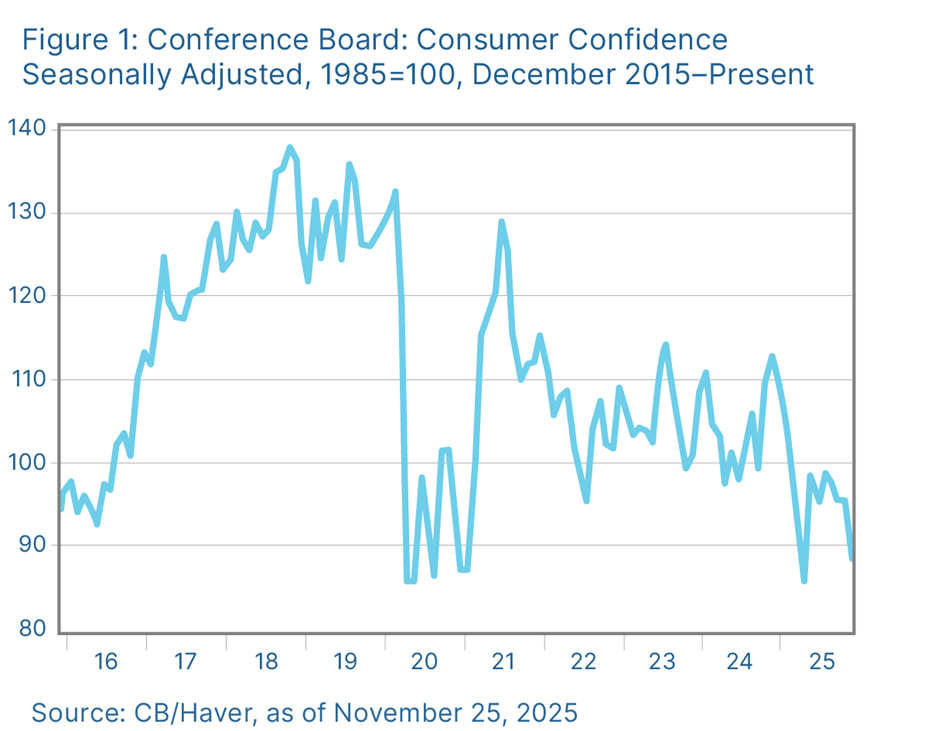
Consumers appear to be noticing these headwinds, as consumer confidence continued to falter in November. The Conference Board’s Consumer Confidence Index fell more than expected in November. As seen in Figure 1, this brought confidence to a seven-month low. The headline drop in consumer confidence was driven by rising concerns about the present economic situation as well as souring expectations for the future. Historically, consumer confidence has been a driver of consumer spending, so this is an important area to keep an eye on in the months ahead.
The Takeaway
- We’re still dealing with shutdown-related data delays.
- Hiring rebounded in September, but the unemployment rate rose during the month.
- Consumer sentiment soured in November.
Looking Ahead: Cautious Optimism Despite Ongoing Risks
Ultimately, while the fundamentals remain supportive, markets continue to face real risks that should be monitored. Domestically, political uncertainty remains the most pressing risk, despite the end of the government shutdown. Economists and investors continue to grapple with the impacts from the delayed data releases, which adds to the uncertainty.
Foreign risks remain as well. The ongoing conflicts in Europe and the Middle East continue to serve as potential sources of geopolitical uncertainty that have the potential to impact markets. There are also the unknown risks that could appear at any time and lead to further turbulence.
Overall, however, things remain pretty good as we head to the end of 2025. Market fundamentals remain strong, with healthy earnings growth and solid expectations. Monetary policy is supportive, and another potential rate cut in December would be a further tailwind for investors. And the impact of the shutdown is set to fade as we get more information in the weeks and months ahead. All in all, the most likely path forward is for further economic growth and market appreciation as we head to the end of the year.
As always, a well-diversified portfolio that matches investor goals and timelines remains the best path forward for most. If concerns remain, you should speak to your financial advisor to review your financial plans.
Disclosure: This material is intended for informational/educational purposes only and should not be construed as investment advice, a solicitation, or a recommendation to buy or sell any security or investment product. Please contact your financial professional for more information specific to your situation.
Certain sections of this commentary contain forward-looking statements based on our reasonable expectations, estimates, projections, and assumptions. Forward-looking statements are not guarantees of future performance and involve certain risks and uncertainties, which are difficult to predict. Past performance is not indicative of future results. Diversification does not assure a profit or protect against loss in declining markets. All indices are unmanaged and investors cannot invest directly into an index. The Dow Jones Industrial Average is a price-weighted average of 30 actively traded blue-chip stocks. The S&P 500 Index is a broad-based measurement of changes in stock market conditions based on the average performance of 500 widely held common stocks. The Nasdaq Composite Index measures the performance of all issues listed in the Nasdaq Stock Market, except for rights, warrants, units, and convertible debentures. The MSCI EAFE Index is a float-adjusted market capitalization index designed to measure developed market equity performance, excluding the U.S. and Canada. The MSCI Emerging Markets Index is a market capitalization-weighted index composed of companies representative of the market structure of 26 emerging market countries in Europe, Latin America, and the Pacific Basin. It excludes closed markets and those shares in otherwise free markets that are not purchasable by foreigners. The Bloomberg Aggregate Bond Index is an unmanaged market value-weighted index representing securities that are SEC-registered, taxable, and dollar-denominated. It covers the U.S. investment-grade fixed-rate bond market, with index components for a combination of the Bloomberg government and corporate securities, mortgage-backed pass-through securities, and asset-backed securities. The Bloomberg U.S. Corporate High Yield Index covers the USD-denominated, non-investment-grade, fixed-rate, taxable corporate bond market. Securities are classified as high-yield if the middle rating of Moody’s, Fitch, and S&P is Ba1/BB+/BB+ or below. One basis point (bp) is equal to 1/100th of 1 percent, or 0.01 percent.
Weller Financial Group is located at 6206 Slocum Road, Ontario, NY 14519 and can be reached at 315-524-8000. Advisory Services offered through Commonwealth Financial Network®, a Registered Investment Adviser.
Authored by Chris Fasciano, chief market strategist, and Sam Millette, director, fixed income, at Commonwealth Financial Network®.
© 2025 Commonwealth Financial Network®